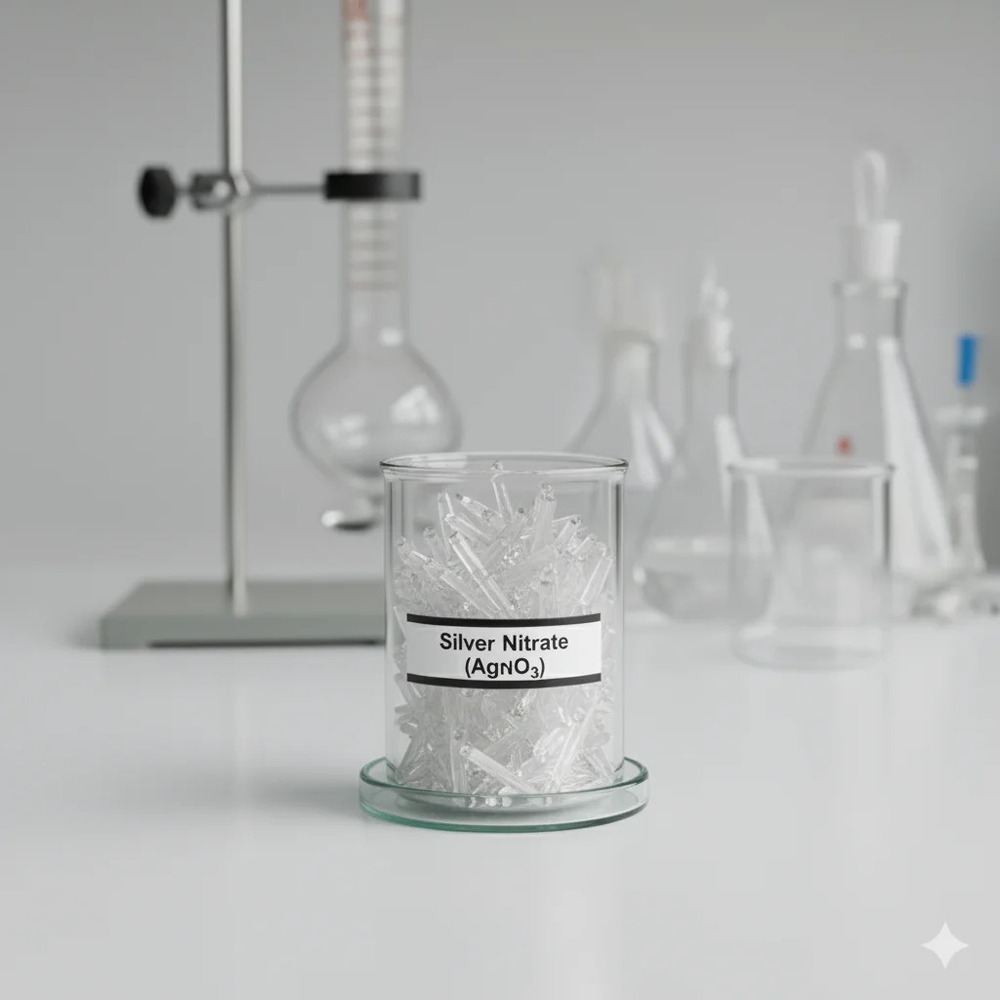
Silver Nitrate
| Unit of Price | Kilograms/Kilograms |
| Price | 5000 INR |
| Unit of Measure | Kilograms/Kilograms |
| Chemical Name | Silver Nitrate |
| CAS No | 7761-88-8 |
| Purity | 99% minimum |
| Poisonous | Yes |
| Main Material | Silver (Ag) |
| Standard | Meets AR / LR specifications |
| Classification | Inorganic Nitrate Salt |
| Melting Point | 212 C (decomposes) |
| HS Code | 28432100 |
| Structural Formula | [Ag]+[NO3]- |
| Density | 4.35 Gram per cubic centimeter(g/cm3) |
| Molecular Weight | 169.87 g/mol |
| Form | White solid |
| Type | Inorganic compound |
| Application | Laboratory reagent, photographic industry, analytical chemistry, medicine, silver plating |
| Taste | Bitter-metallic |
| Storage | Store in tightly closed container, protected from light, at room temperature |
| Refractive Rate | nD 1.505 |
| Non Toxic | Yes |
| Grade | AR (Analytical Reagent), LR (Laboratory Reagent) |
| Usage | For chemical synthesis; in photography and microscopy |
| Ph Level | Around 5.4 to 6.4 (5% aqueous solution) |
| EINECS No | 231-853-9 |
| Molecular Formula | AgNO3 |
| Solubility | Soluble in water and ammonia |
| Smell | Odorless |
| Shape | Crystalline |
| Boiling point | 444 C (decomposes) |
| Other Names | Lunar caustic, Nitric acid silver(I) salt |
Buy Online premium Silver Nitrate, renowned for its lustrous, colorless or white crystalline form and marvelous purity of 99% minimum. This distinguished inorganic compound is favored for chemical synthesis, photography, analytical chemistry, and medicine. Available in HDPE or glass packaging, our Silver Nitrate meets strict AR/LR specifications and is stable under normal conditions with a 24-month shelf life. Reserve your stock now during clearance! Caution: Strong oxidizer, causes burns, and hazardous to the environment. Store protected from light in tightly closed containers.
Material Features & Diverse Applications of Silver Nitrate
Silver Nitrate offers a distinguished profile as a stable, odorless, and highly soluble crystalline solid containing pure AgNO3. Its lustrous nature makes it essential for analytical chemistry, laboratory reagents, photographic industry, medicine, and silver plating. With a high aqueous conductivity and strong oxidizing properties, its uses span both general and specialized scientific fields. This marvelous compound is designed for both general and advanced laboratory operations, offering reliability and excellent results in all applications.
Packaging Details, Sample Policy, and Supply Ability
Order Completion is seamless with our robust packaging options, including HDPE bottles, glass containers, and drums tailored for international Goods Transport. We provide sample estimates upon request to help you make informed decisions before bulk purchase. Our excellent supply ability ensures continuous availability of Silver Nitrate throughout India and for export abroad. Timely processing and careful packaging uphold product integrity from warehouse to your laboratory, ensuring you always receive uncompromised quality.
Material Features & Diverse Applications of Silver Nitrate
Silver Nitrate offers a distinguished profile as a stable, odorless, and highly soluble crystalline solid containing pure AgNO3. Its lustrous nature makes it essential for analytical chemistry, laboratory reagents, photographic industry, medicine, and silver plating. With a high aqueous conductivity and strong oxidizing properties, its uses span both general and specialized scientific fields. This marvelous compound is designed for both general and advanced laboratory operations, offering reliability and excellent results in all applications.
Packaging Details, Sample Policy, and Supply Ability
Order Completion is seamless with our robust packaging options, including HDPE bottles, glass containers, and drums tailored for international Goods Transport. We provide sample estimates upon request to help you make informed decisions before bulk purchase. Our excellent supply ability ensures continuous availability of Silver Nitrate throughout India and for export abroad. Timely processing and careful packaging uphold product integrity from warehouse to your laboratory, ensuring you always receive uncompromised quality.